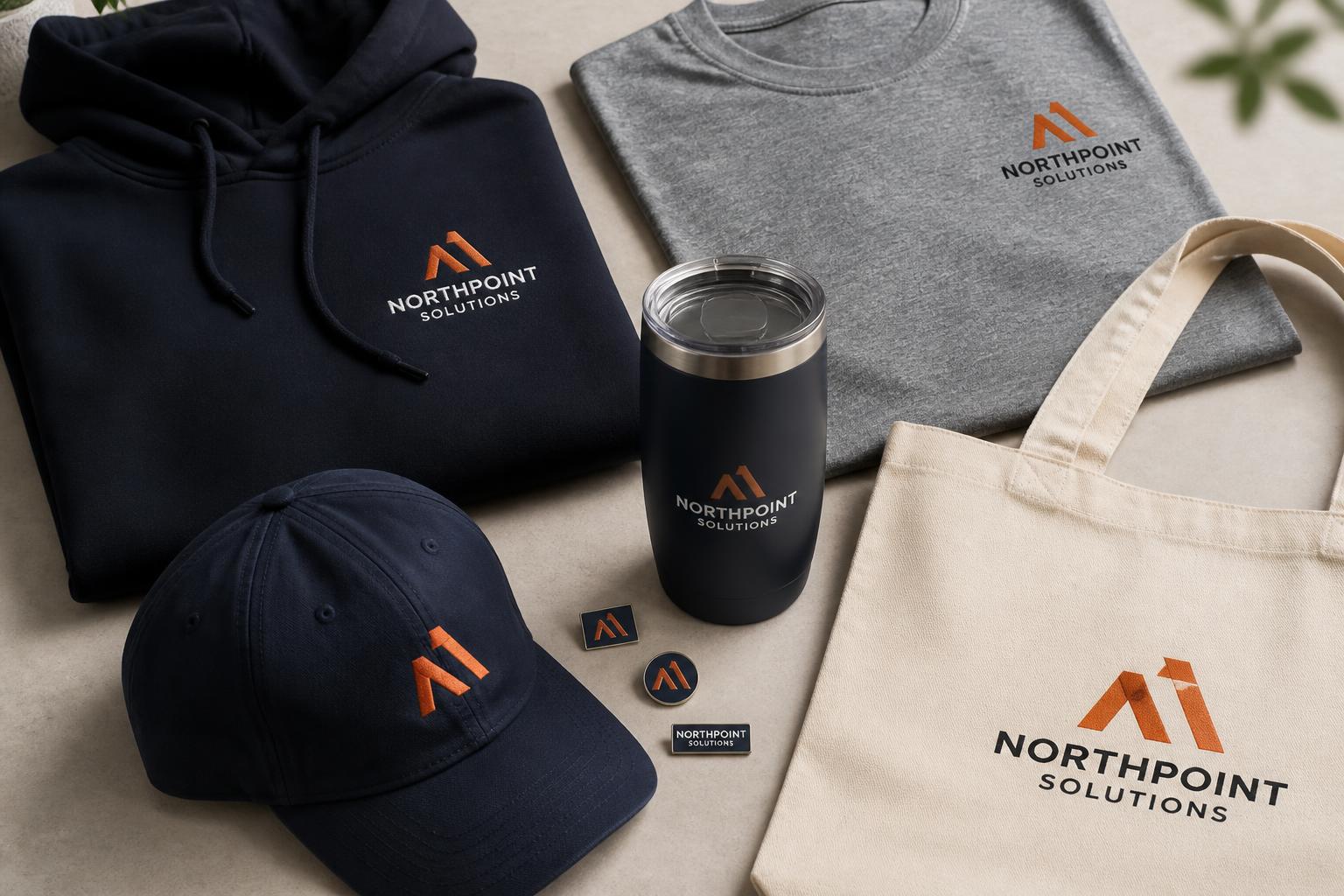
Every organization eventually hits the same wall. Somebody wants shirts. The quote comes back with a 144-piece minimum, three sizes you will never sell, and a four-week lead time. You place the order anyway, and eighteen months later a third of that box is still sitting in a supply closet in the wrong sizes.
A no-inventory custom apparel model removes that whole failure mode. This guide walks through exactly how to launch a company swag store in 2026 — the product mix, the artwork process, pricing rules, launch week, and how to keep the store producing orders after the initial excitement fades.
What a no-inventory swag store actually is
A no-inventory swag store is a branded online storefront where each item is produced only after someone buys it. There is no bulk purchase, no minimum order quantity, and no warehousing. The catalog exists digitally; the physical product is created on demand and shipped to whoever ordered it.
Three things make it work:
- On-demand production. Embroidery, DTG and screen-print partners produce single units at low per-item pricing instead of requiring case packs.
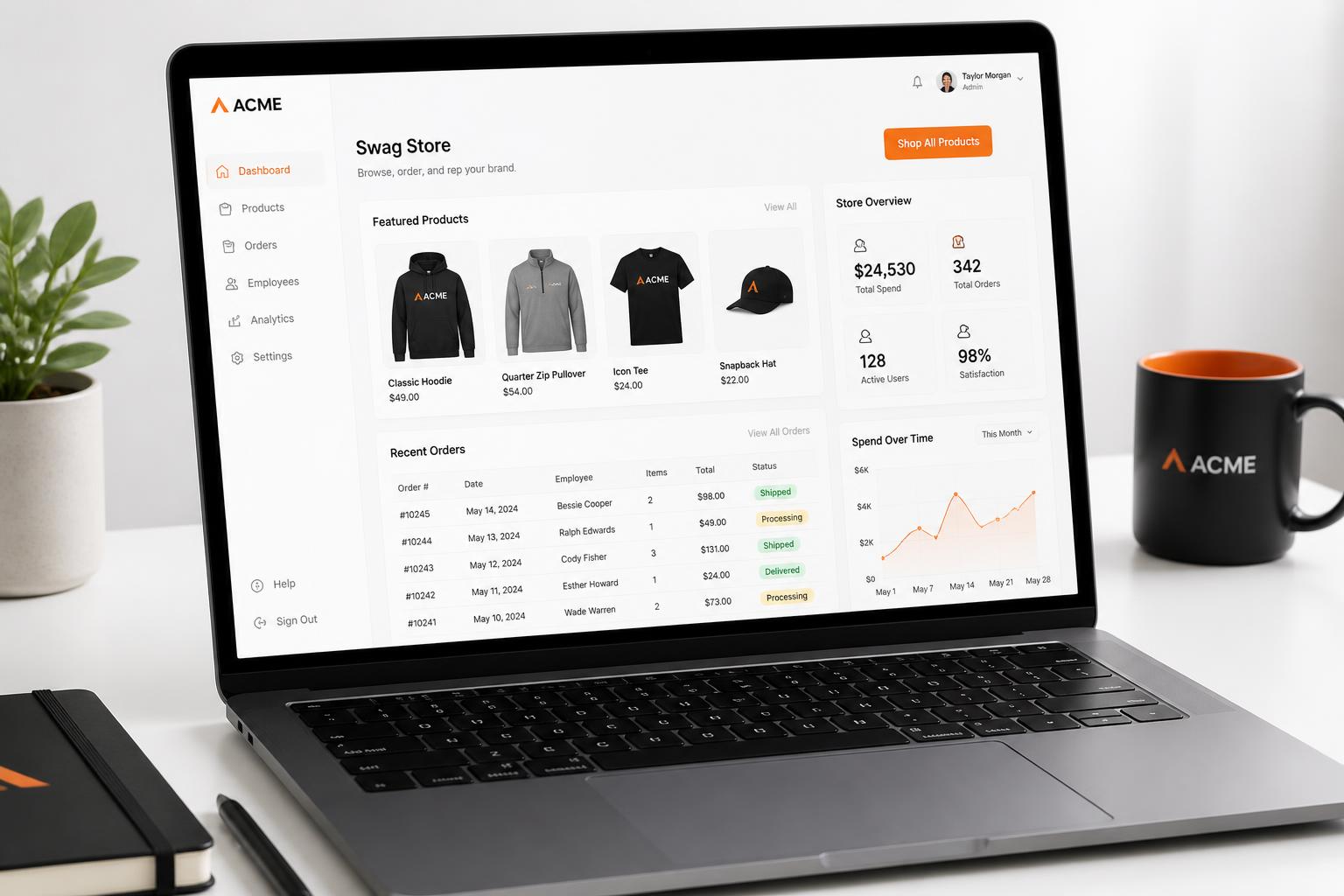
- A hosted storefront. Your catalog, checkout, order routing, and reporting all live in one place — see the full platform features for what that includes.
- Design automation. AI custom apparel design turns a logo into print-ready artwork across dozens of garment colors and placements without a designer round-trip for every SKU.

The result is that your risk per product drops to effectively zero. If a hoodie color does not sell, you did not buy 60 of them — you simply retire the SKU.
Why bulk swag orders quietly lose money
The problem with bulk swag is not the unit price. Bulk unit prices look great on a quote. The problem is everything the quote does not include.
The costs nobody puts in the spreadsheet
- Unsold stock. Size curves are guesses. A realistic 25–35% of a bulk apparel order never gets distributed.
- Storage and handling. Someone becomes the unofficial warehouse manager, and that time is real payroll.
- Fulfillment labor. Counting, bagging, and mailing individual shirts is slow and thankless.
- Design obsolescence. Rebrands, tagline changes, and sponsor updates instantly write off remaining stock.
- Opportunity cost. Capital sitting in a closet is not funding the campaign that would have sold more swag.
The version that scales
With a branded swag program built on demand-based production, each of those line items goes to zero or near-zero. You trade a slightly higher per-unit cost for the elimination of waste, storage, and labor — and in almost every program we have seen, the total landed cost per delivered item comes out lower.
The numbers: bulk vs. no-inventory
Here is the comparison for a typical 250-person program with a mixed apparel and drinkware catalog. The figures are illustrative but reflect the pattern we see in real launches.
Upfront cost to launch
Unsold / unused stock
Days to launch
Read it in the direction that matters: the bulk order requires thousands of dollars before a single person has said they want a shirt, and it takes roughly six weeks to reach the point where anyone can actually order. The no-inventory store reaches the same point in under a week with nothing spent upfront.
Step 1: Define who the store is for
Before you pick a single product, answer one question: who is buying, and with whose money?
- Employees and staff. Focus on wearability. Quarter-zips, soft tees, and outerwear beat novelty items every time. This is the standard company swag store setup.
- Members and community. Churches, schools, and nonprofits sell to supporters who want to signal affiliation. See how it works for churches, schools and nonprofits.
- Field and service teams. Uniform-adjacent apparel with durable embroidery, sized for daily wear — the usual pattern for home services companies.
- Client-facing professionals. Closing gifts and referral swag drive most of the volume for real estate teams.
- Clients and prospects. Higher-quality, giftable items shipped individually — this is where corporate gifting belongs, and it should usually be a separate collection from the staff store.
Write down the primary audience in one sentence. Every later decision — catalog, price band, payment model — follows from it.
Step 2: Build a catalog people actually wear
The single most common launch mistake is too many products. A 40-SKU store converts worse than a 10-SKU store because choice paralysis is real and because thin demand across many items makes nothing look popular.

A proven starter catalog
- One premium soft tee (the volume driver, usually 40–50% of orders)
- One mid-weight hoodie and one quarter-zip — the quarter-zip outperforms in professional settings
- One structured cap and one beanie if you have a cold season
- One insulated tumbler or bottle
- One bag: tote for community audiences, backpack or duffel for staff
- One "fun" seasonal item — an anniversary tee, a holiday piece, an event drop
Quality is the retention lever
People wear brands they like the feel of. Stocking recognizable labels like Nike, Adidas, and Under Armour alongside your blanks raises perceived value and average order value at the same time. A branded quarter-zip someone wears weekly is worth ten koozies.
Step 3: Use AI custom apparel design to get to artwork fast
Artwork is historically the slowest step in launching a store. A designer produces a mockup, someone requests a color change, the file bounces back, and a week disappears.
AI custom apparel design compresses that loop. You provide a logo and a short description of the look — "clean athletic wordmark, tonal on charcoal, small left chest" — and get print-ready variations across garment colors and placements in minutes.
What still needs a human
AI does not replace judgment. Before anything goes into the store, confirm:
- Print method fit. Fine gradients that look great on screen do not embroider well. Simplify for stitch counts.
- Contrast on every garment color. A navy mark on a navy hoodie needs an alternate lockup.
- Placement scale. Left-chest marks between 3 and 4 inches wide read best on adult apparel.
- Brand rules. Clear space, approved color values, and no unauthorized logo distortion.
Every design in a My Swag Shop store gets a human review pass before it goes live. Speed without a proof step just produces fast mistakes.
Step 4: Set pricing, shipping and payment rules
There are three payment models, and picking the wrong one is the quietest way to kill a store.
- Self-pay retail. Everyone pays the listed price. Best for community, alumni, fan, and supporter stores. Zero budget required.
- Subsidized. The organization covers a fixed portion — for example $15 off any item — and the buyer pays the rest. This roughly doubles participation compared with full self-pay.
- Allowance or credit. Each person receives a code worth a set amount, typically at onboarding or annually. Best for staff uniform programs and new-hire kits.
Pricing guidance
- Keep the entry tee under $30. It anchors the perceived value of everything else.
- Do not price at exact cost. A small margin funds free-shipping thresholds and giveaway inventory.
- Publish shipping expectations on the product page. On-demand items typically ship in 5–8 business days; saying so upfront removes most support tickets.
- If you run fundraising, show what the proceeds fund. Purpose-driven stores routinely outperform discount-driven ones.
Step 5: Launch week: how to drive the first orders
A store with no launch plan gets a trickle of orders and then silence. Treat the opening like a product launch, because it is one.
Two weeks out: finalize catalog and artwork, run a small internal test order to confirm quality and fit, and photograph a few real items on real people.
One week out: tease it. One email or team message with a single hero image and a date. No link yet.
Launch day:
- Send one email with a single clear call to action and three featured products — not the whole catalog.
- Post the same three products where your audience already is: team chat, member newsletter, social.
- Give leaders and managers the assets to share directly. Peer sharing outperforms company-wide broadcast.
- Add a launch-window incentive that costs nothing structural: free shipping over a threshold, or a limited seasonal design available for two weeks.
Week two: send a follow-up featuring the actual best seller with a photo of someone wearing it. This second email consistently produces 30–40% of launch-month volume.
Step 6: Keep the branded swag program alive
Stores decay when they become static catalogs. Keep a light calendar:
- Quarterly drops. One or two new designs per quarter gives you a legitimate reason to email.
- Moment-based items. Anniversaries, championships, campaign milestones, new locations.
- Onboarding automation. Every new hire, member, or volunteer gets a store credit on day one.
- A rewards layer. Tying purchases and referrals to a loyalty program turns one-time buyers into repeat ones.
- Reporting review. Check what sold each quarter, retire the bottom two SKUs, and replace them. This is free optimization.
What good performance looks like
For a staff store with a subsidy, 35–55% participation in the first 90 days is a healthy benchmark. For a self-pay community store, 8–15% of your active audience is realistic. If you are well below those, the issue is almost always visibility or product mix, not pricing.
Common mistakes to avoid
- Launching with 40 SKUs. Start narrow, expand from data.
- Only ordering unisex sizing. You will lose a large share of your audience. Offer women's cuts and extended sizes from day one.
- Hiding the store. If it is not linked from your site nav, email footer, and onboarding docs, it does not exist.
- Treating swag as a one-time project. The second and third drops are where programs compound.
- Over-designing. Restrained, well-made marks get worn. Loud full-front prints sit in drawers.
Ready to launch your store?
A no-inventory company swag store removes the two things that have always made branded merchandise painful: money spent before demand exists, and boxes nobody wants to manage. What is left is the good part — people wearing your brand.
If you want a store built with your catalog, your artwork, and your payment rules, schedule a call and we will map the whole program with you. Setup is free, there are no minimums, and there is nothing to store.
Frequently asked questions
Start your swag store
Zero minimums, zero inventory, and free store setup. See how a branded swag program works for your organization.